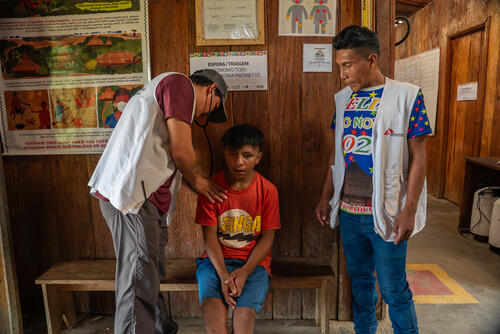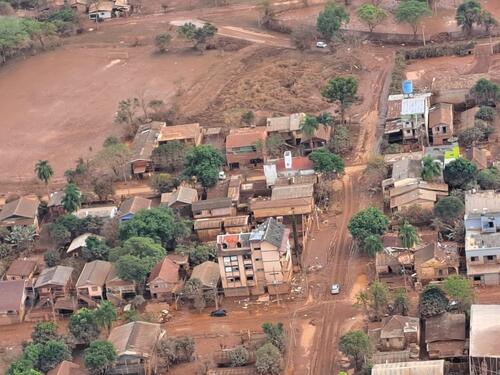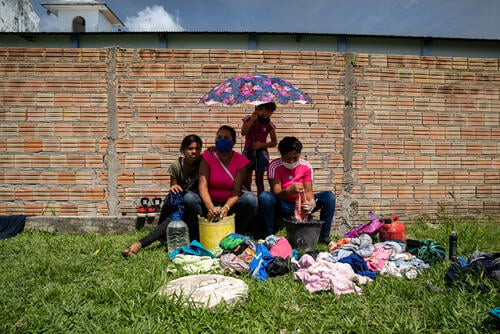
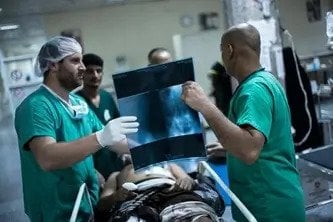
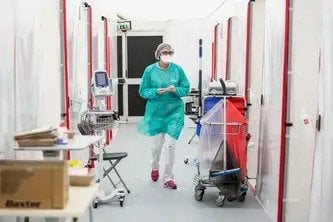
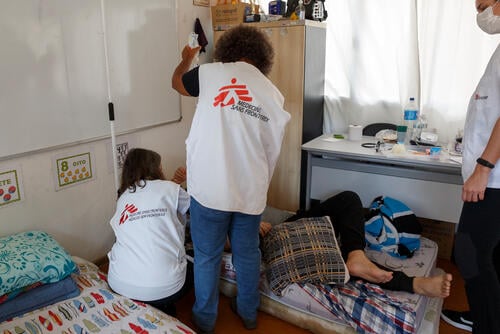
About 400 people now live in this shelter at the Paulo Freire Municipal School. The place has been receiving people from many neighborhoods of Canoas. It’s the state’s third most populous city, with 350 thousand inhabitants, and 180 thousand of them had to leave their homes. The space previously used by students is now occupied by whole families. And there are many of them, housed in makeshift accommodations after torrential rains flooded whole cities and left hundreds of thousands of people without shelter in May 2024. A team of Médecins Sans Frontières/Doctors Without Borders (MSF), with doctors, nurses, psychologists and health promoters, offer medical and mental health assistance to the people in the shelter.
About 400 people now live in this shelter at the Paulo Freire municipal school. The place has been receiving people from many neighborhoods of Canoas after torrential rains flooded whole cities and left hundreds of thousands of people without shelter. Brazil, May 2024.
© Diego Baravelli/MSF

In Brazil, our teams deliver healthcare to hard-to-reach communities. We offer general care and malaria treatment to people who often do not have access to healthcare because of difficult terrain and a shortage of medical staff.

Our activities in 2025 in Brazil

Data and information from the International Activity Report 2025.

MSF in Brazil in 2025 In 2025, MSF concluded two projects that delivered healthcare to hard-to-reach communities in Brazil.
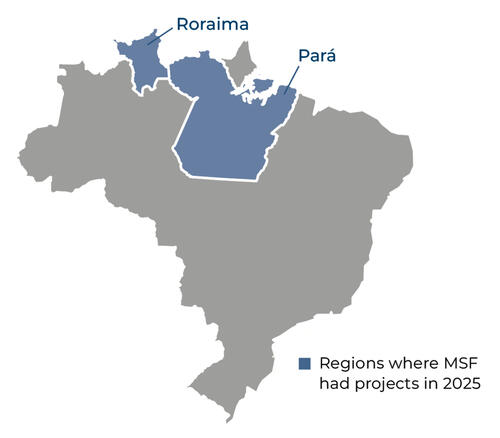
Country map for the IAR 2025.
© MSF
In 2025

In the Yanomami Indigenous Territory, in Auaris region, Roraima state, MSF focused on diagnosis and treatment of malaria, and mental health services. Around 30,000 people live in communities scattered across the territory. In the state capital, Boa Vista, our teams supported the health centre, which is the referral facility for Yanomami patients. We also conducted health promotion sessions in the community and upgraded sanitation infrastructure.

We closed our project in Roraima state in 2025, after nearly three years of activities. The successful collaboration between MSF teams and the Indigenous communities created a lasting legacy for the region, and for MSF. The health facilities and services we strengthened will continue to serve local people, while the experience of adapting medical approaches, using traditional knowledge and learning shared by the Indigenous communities, will inform future MSF projects. Before our departure, we conducted training for healthcare staff and community members to ensure a sustainable transition.

In Portel, a town located about 16 hours by boat from the Pará state capital, Belém, MSF delivered comprehensive healthcare to riverside and rural communities. We also worked to improve care for victims and survivors of sexual violence, establishing two specialised reception rooms to guarantee their privacy at medical facilities, and offering training to health professionals and staff from other areas.  

With support from MSF, post-exposure prophylaxis (PEP), an HIV prevention medication, became more readily available for both adults and children in Portel. For the first time, a paediatric formulation was introduced in the city, and PEP for adults could be acquired at health facilities other than the hospital.  

We concluded our medical activities in Portel in June. In the same month, we celebrated another important legacy of our work: the establishment of a public policy regarding care of children and adolescents who are victims of sexual violence, which we had influenced.  

Brazil

Language
English