- For six months in 2025, violence at the so-called Gaza Humanitarian Foundation's militarised food distribution points caused thousands of casualties in Gaza, Palestine.
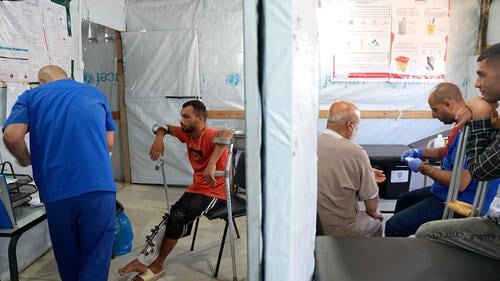
- One year on, MSF treats scores of patients who were impacted by this violence, and are living with trauma and even life-long injuries.
- Amid evolving plans for the Gaza Strip, MSF reminds Israel and the US that the militarisation of humanitarian assistance risks causing grave violence and harm and should never be replicated.
Jerusalem/Amman – One year ago, the so-called Gaza Humanitarian Foundation (GHF) started operating militarised food distribution points across the Gaza Strip, Palestine, replacing the UN-coordinated aid distribution system. The GHF, run by Israel with financial support from the United States (US) and other allies, closed within six months, as its related violence killed and injured thousands.1 Médecins Sans Frontières (MSF) still treats scores of patients impacted by this violence, who are living with trauma and even life-long injuries. Amid evolving plans for the Gaza Strip, MSF reminds Israel and the US that the militarisation of humanitarian assistance risks causing grave violence and harm, and should never be replicated.
“As MSF documented with medical evidence, people who were seeking food in desperate and siege-like conditions suffered horrendous levels of targeted and indiscriminate violence,” says Joan Tubau, MSF head of mission for Palestine. “Children were shot in the chest while reaching for food, people were crushed or suffocated in stampedes, and entire crowds were gunned down at distribution points.”
Children were shot in the chest while reaching for food, people were crushed or suffocated in stampedes, and entire crowds were gunned down at distribution points.Joan Tubau, MSF head of mission for Palestine
“Today many GHF-related patients are entirely dependent on charity and community kitchens due to their mobility issues, and lack of ability to work and provide for their families,” says Tubau.
The GHF was established to deliver food assistance to people in Gaza, following months of Israel’s total blockade, replacing some 400 existing aid sites. The four GHF sites became operational in late May 2025 and were ‘secured’ by private American armed contractors, with the Israeli forces maintaining control over the wider perimeter.
Between June and October 2025, MSF teams recorded at least 32 deaths and treated 1,885 patients for injuries at MSF’s Al-Attar and Al-Mawasi healthcare centres in Khan Younis.
“My friend was executed in front of my eyes. It still haunts me,” says Karim, who was a barber. He suffered life-changing injuries, permanently damaging a nerve in his leg. “Both of us were caught and handcuffed (by Israeli soldiers) behind our backs. A drone was called above me, and four men were asked to take me away.”
My friend was executed in front of my eyes. It still haunts me. Both of us were caught and handcuffed (by Israeli soldiers) behind our backs.Karim, a barber who suffered life-altering injuries
Another patient, Muhammad, received nine gunshots. He hopes to walk again but suffers chronic pain and needs physiotherapy.
“There was never enough food for everyone,” says Muhammad. “There was a lot of crushing because the narrow iron gates were not wide enough.”
“I saw many dead, including women. One was shot in the chest and one in the back,” he says. “They were shooting at many different points.”
“The Israeli soldier shooting at me was stationed on a hill,” he continues. “While lying on the ground, I waved ‘please stop, that’s enough’. But he shot at my hands just for fun.”
Mustafa, a taxi driver from Rafah, developed a heel infection which caused rotting after a gunshot wound broke two of his bones.
“GHF was so humiliating; thousands of people would run towards it, then the IDF [Israeli Defence Forces] would shoot on us from fixed points,” says Mustafa, whose 17-year-old nephew was shot in the head and killed by a sniper. “Two-thirds of the injured people in Gaza I know were cases from GHF.”
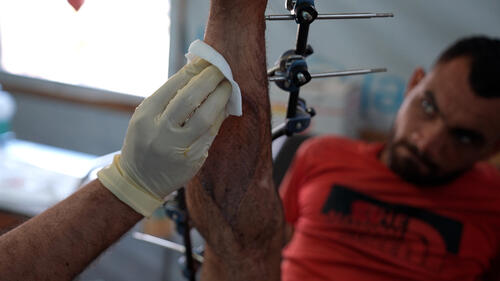
These testimonies are reflective of many who have been forced to live with external fixators or who still require close and constant medical follow-up.
“Despite its temporary existence, this devastating aid scheme brought broader social consequences,” says Nicholas Papachrysostomou, MSF emergency coordinator for Gaza. “It forced people into extreme fear, scarcity, and competition, leading to trauma and changes in community dynamics.”
The GHF also played a key role in the malnutrition crisis manufactured by Israel. The drastic reduction of food and aid distribution points – compounded by the total siege, intensified violence, mass displacement, and destruction of health facilities – had a direct role in the famine declared in mid-2025.2 This had devastating consequences on vulnerable groups such as pregnant women, newborns, and children.
Nothing about GHF was a humanitarian solution.Joan Tubau, MSF head of mission for Palestine
“Nothing about GHF was a humanitarian solution,” says Tubau. “One year on, the magnitude of the harm inflicted on people at GHF distribution points, without any accountability, requires an independent investigation.”
“The International Court of Justice ruling of 22 October 2025 reinforces Israel’s obligation to ensure unhindered humanitarian access, and condemns aid models, including the GHF, which fail to alleviate suffering,” says Tubau.
MSF calls on Israel, the US, and all organisations, groups and governments of influence to ensure that aid is non-militarised, accessible, and built on independence, impartiality, neutrality, and humanity. Humanitarian assistance must be able to reach all civilians in safety, based on need, wherever they choose to reside, and at scale.
*All patient names changed to protect identity.
There is no official cumulative account on the total number of casualties associated to GHF. OHCHR has said it caused over 2,140 deaths (September 2025) and more than 4,000 injured (August 2025), but these figures are estimated to be largely an undercount. Casualties include also those caused in supply routes as desperate people tried to access food.
Integrated Food Security Phase Classification (IPC): https://www.ipcinfo.org/ipcinfo-website/countries-in-focus-archive/issue-134/en/